Every steel stockholding feature, in plain English.
What each part of MetlSys does, and what it saves you. Nothing on this page is a roadmap item dressed up as a feature.
Orders that check themselves before they confirm.
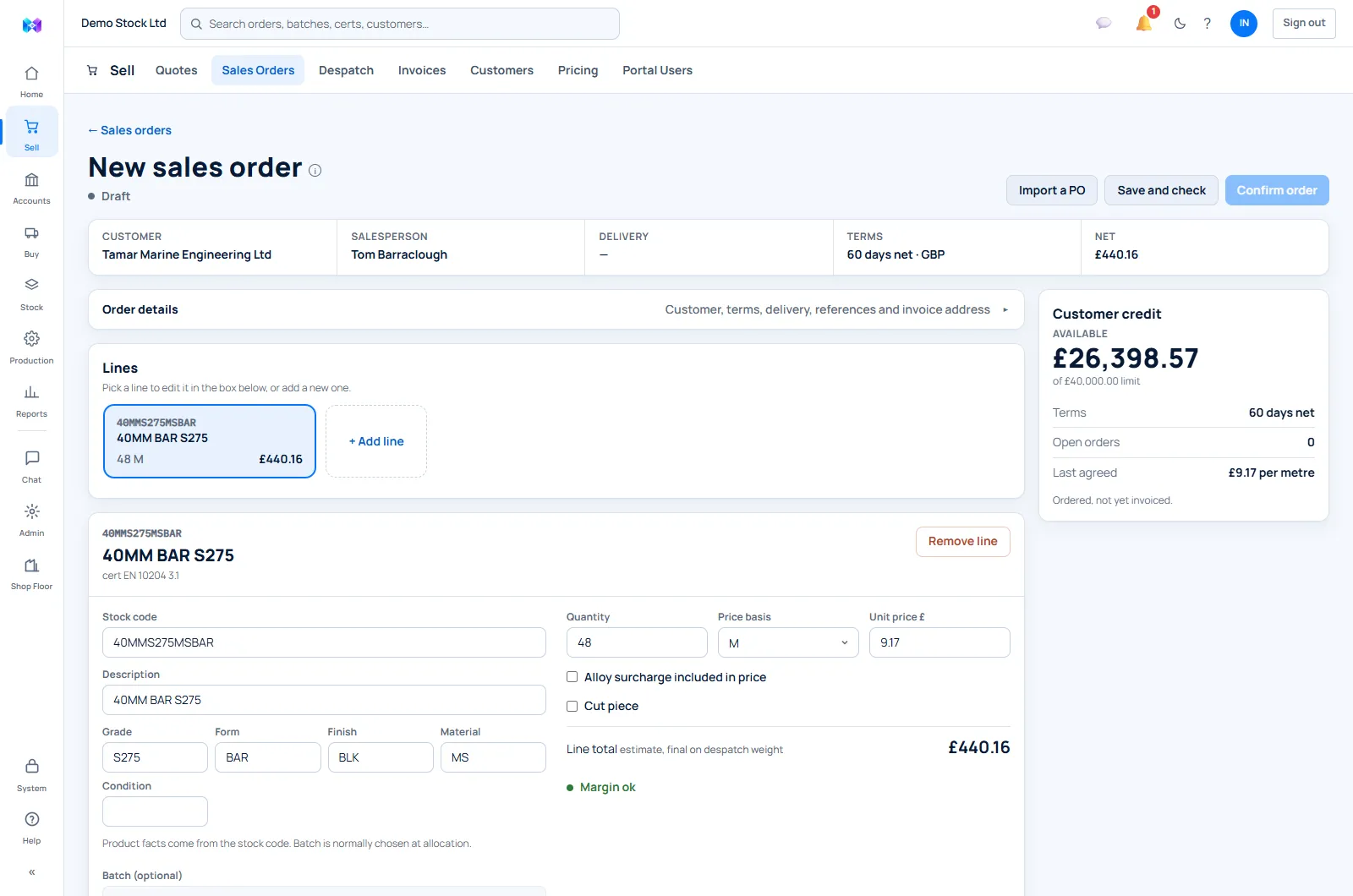
Quotes convert to orders, or the wizard walks the desk through it: customer and delivery, stock availability, surcharges, processing, certificate requirements, final review.
Cut-piece pricing does the arithmetic the trade actually uses. Chargeable length is cut length plus kerf plus a facing allowance each end, kerf set per saw type, with minimum-usable-length flags so you don't promise offcuts that can't exist.
Credit limits, holds and override roles are enforced at confirmation, not discovered at despatch.
What this saves you
No more orders that die at the last minute because the credit hold, the cert requirement or the saw maths turned up late.
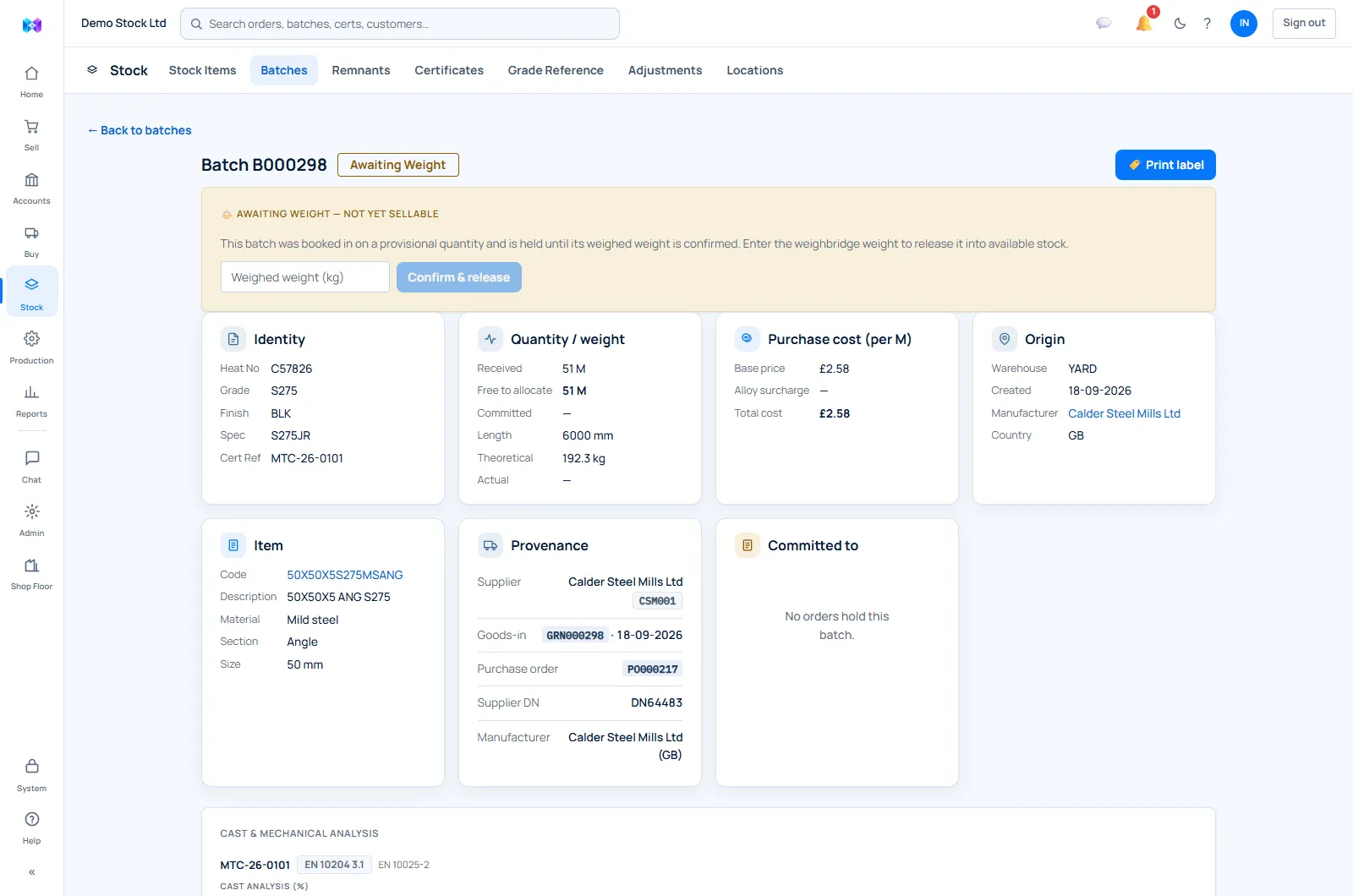
Book it in from the paperwork, weigh it when you can.
GRNs raise against purchase orders, with over/under-delivery advisories from the PO's outstanding quantity.
Drop in the delivery note and mill cert. The AI proposes supplier, heat, grade, quantities and cert type for your review. Nothing posts without a human confirming it.
Two-stage receipt: material books in as awaiting-weight and cannot be sold until the actual weight is confirmed. Batch labels print with QR deep links.
What this saves you
The time someone spent retyping every delivery's paperwork, and the stock errors that came with it.
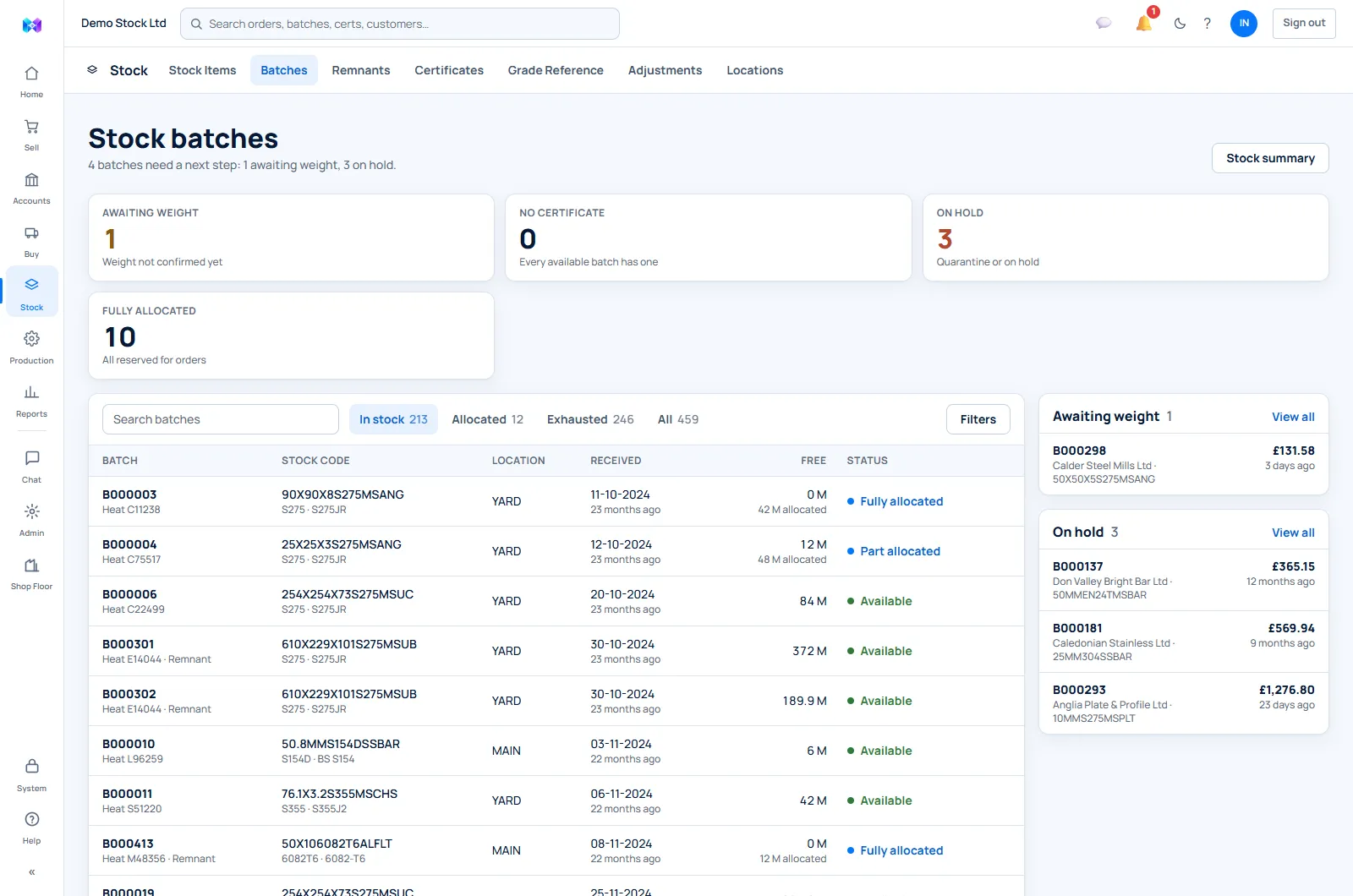
Every lot is a batch, and every batch knows where it lives.
Locations are warehouse → section → bin, not generic shelves. Batches carry quantity, weight, grade, heat, cert, cost and status.
Split, transfer and adjust with a full stock transaction ledger behind every movement. Remnant recommendations score offcuts by heat, waste and age so they get sold, not forgotten.
Pick lists group allocated stock by location, heat and order, with confirm/unpick audit.
What this saves you
Walking the racks with a clipboard, and the remnants that used to vanish into manual notes.
Certificates are records, not attachments.
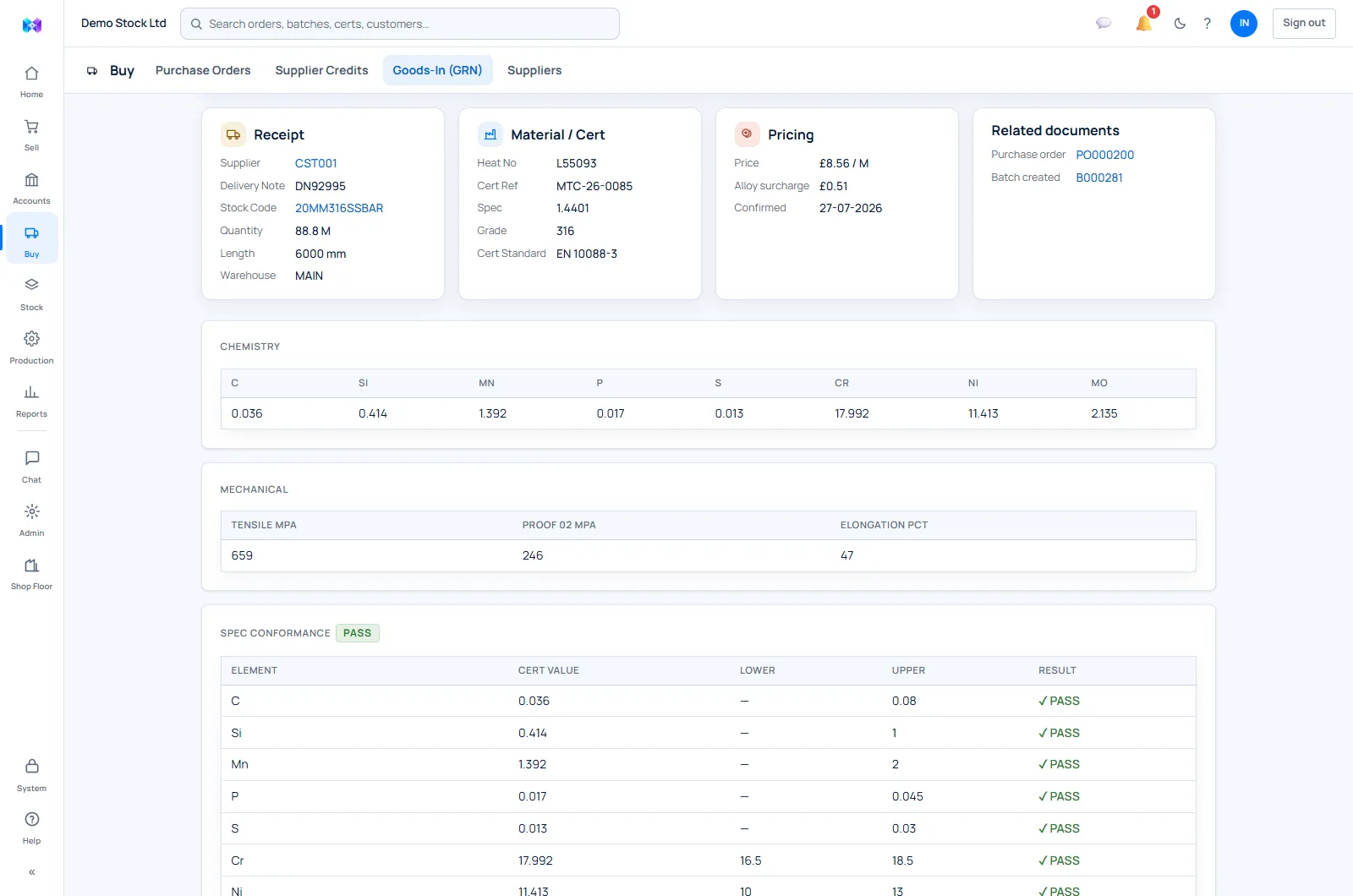
Mill test certificates hold the PDF plus extracted heat, grade, standard, chemistry and mechanical values. They auto-match to batches by heat number.
Certificate types rank 2.1, 2.2, 3.1, 3.2. Customers carry a minimum type; allocation and despatch gate on it, with manager override for deficiencies. All logged, of course.
Cert packs assemble into one PDF for the delivery. Failed or non-conforming material quarantines through the NCR lifecycle.
What this saves you
The audit-day panic, and the 4:45pm Friday phone call asking for a cert you can now send in under a minute.
The subcontract loop, without the blindfold.
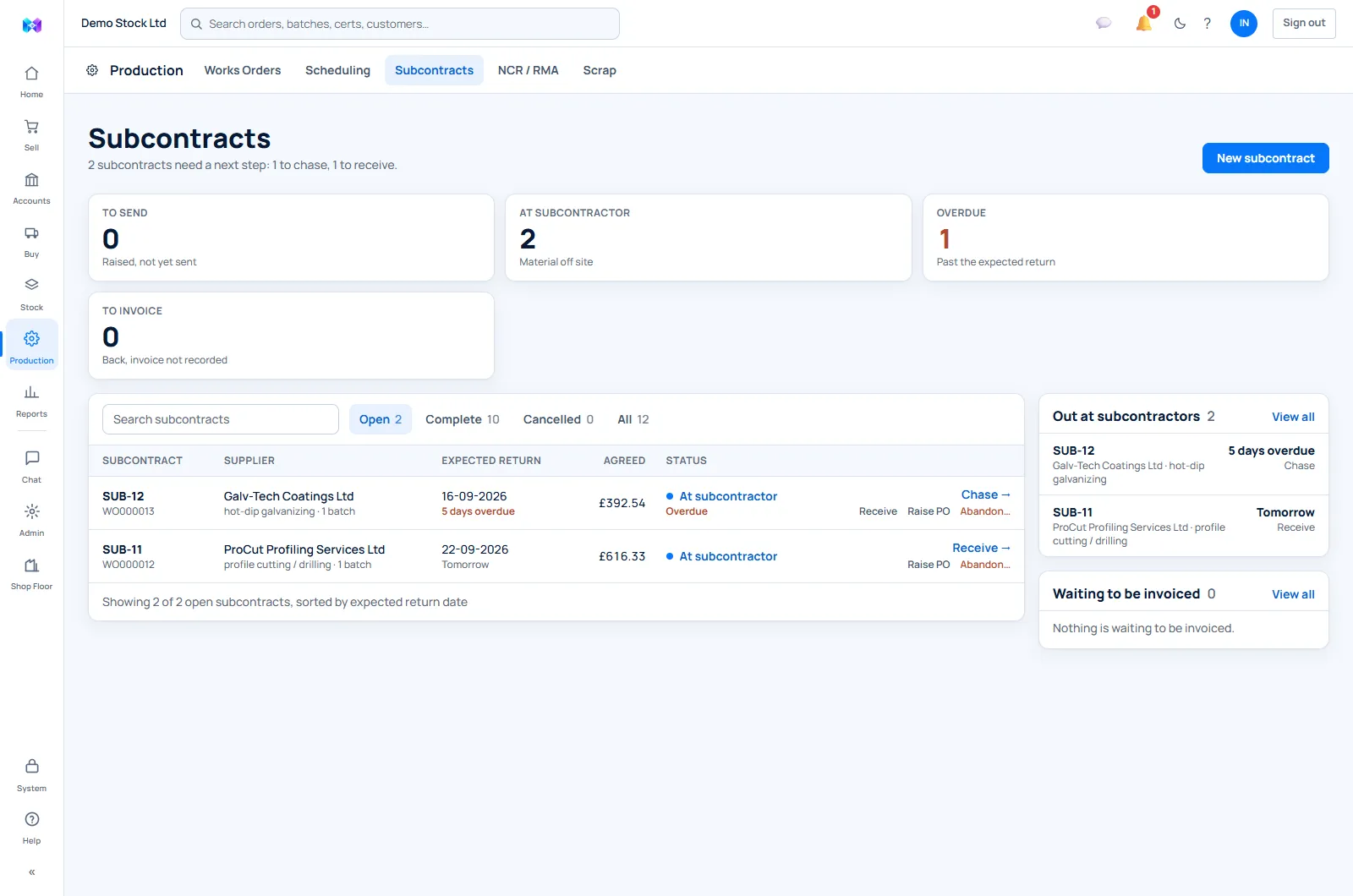
Create subcontract orders by hand or from the subcontractor's confirmation via AI capture. Send material out; it tracks as at-subcontractor.
Passed returns create child batches with the subcontract cost spread across them: same heat, same cert, updated cost basis. Failed returns quarantine with an NCR raised automatically.
The subcontractor's invoice records against the order, so the job's true cost is on the batch.
What this saves you
Material that's 'somewhere at the platers' and costs that never made it onto the job.
Customers fetch their own paperwork.
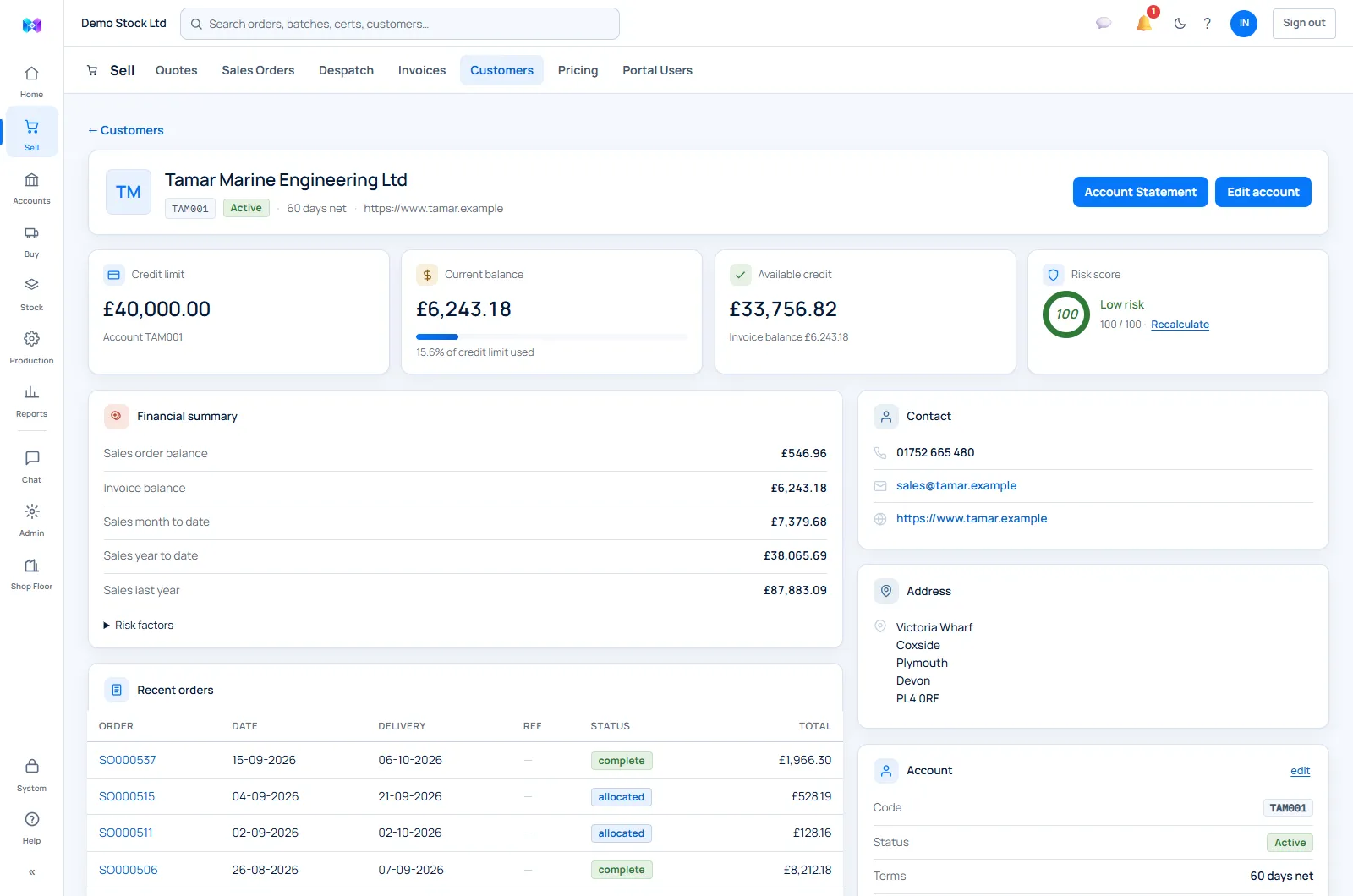
Each customer logs into a portal scoped to their account: orders with friendly statuses, invoices, statements, credit position and notifications.
One click builds a document bundle of delivery notes, cert packs and invoices, served on a short-lived secure link.
Portal users come in buyer, accounts and admin roles, provisioned by you.
What this saves you
The copy-invoice and cert-resend calls that eat the office's afternoons. Theirs and yours.
The operational chain finishes in the ledger.
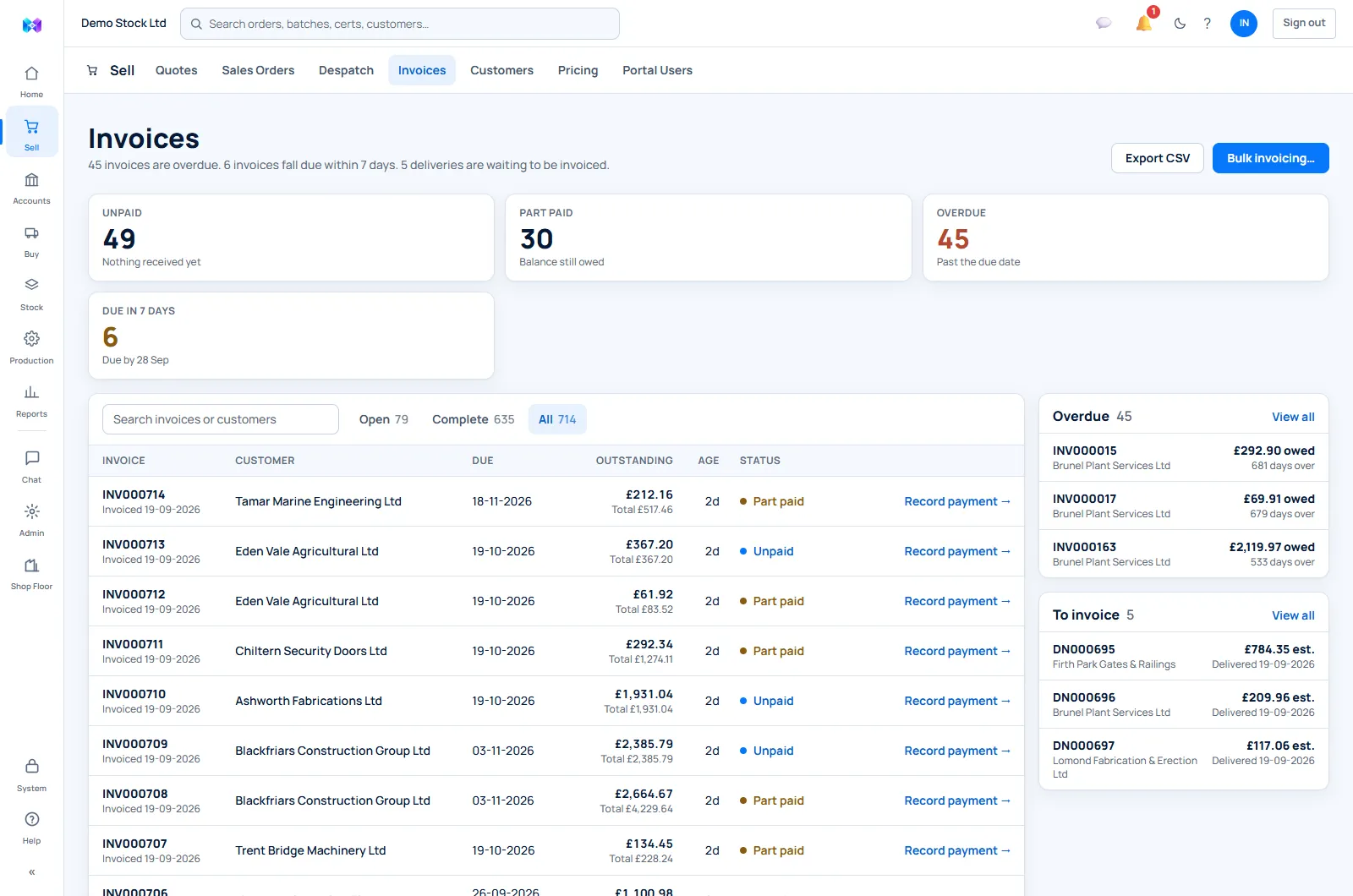
Invoices raise from delivery notes on theoretical or actual weight. Raise them singly, in bulk, or automatically on a clean POD.
Credit notes, part-payments, statements, aged debtors and a dunning ladder with reminder history. Voids and undespatches are two-step and auditable, never silent deletions.
Posting runs export CSV for Xero, Sage 50, Sage 200 and QuickBooks Online, with supplier invoice matching feeding the purchase ledger. It's a clean export, not a live sync. And we say so.
What this saves you
Month-end reconciliation archaeology, and invoices that waited a week for someone to notice the POD was back.
The operating position, live.
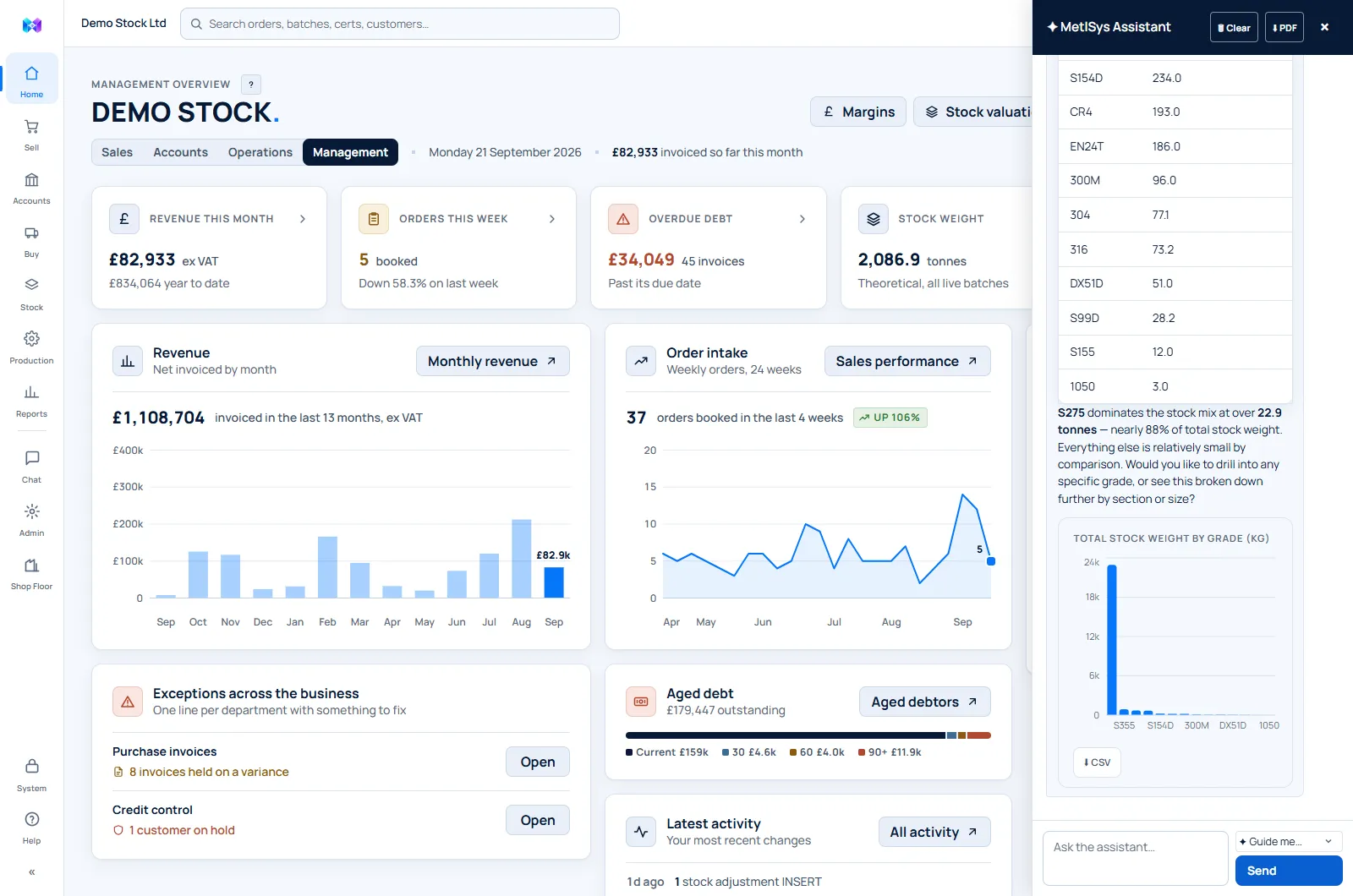
The dashboard shows open orders, despatches today, credit holds, uncertificated batches, stock weight, overdue invoices and more. As of now, not month end.
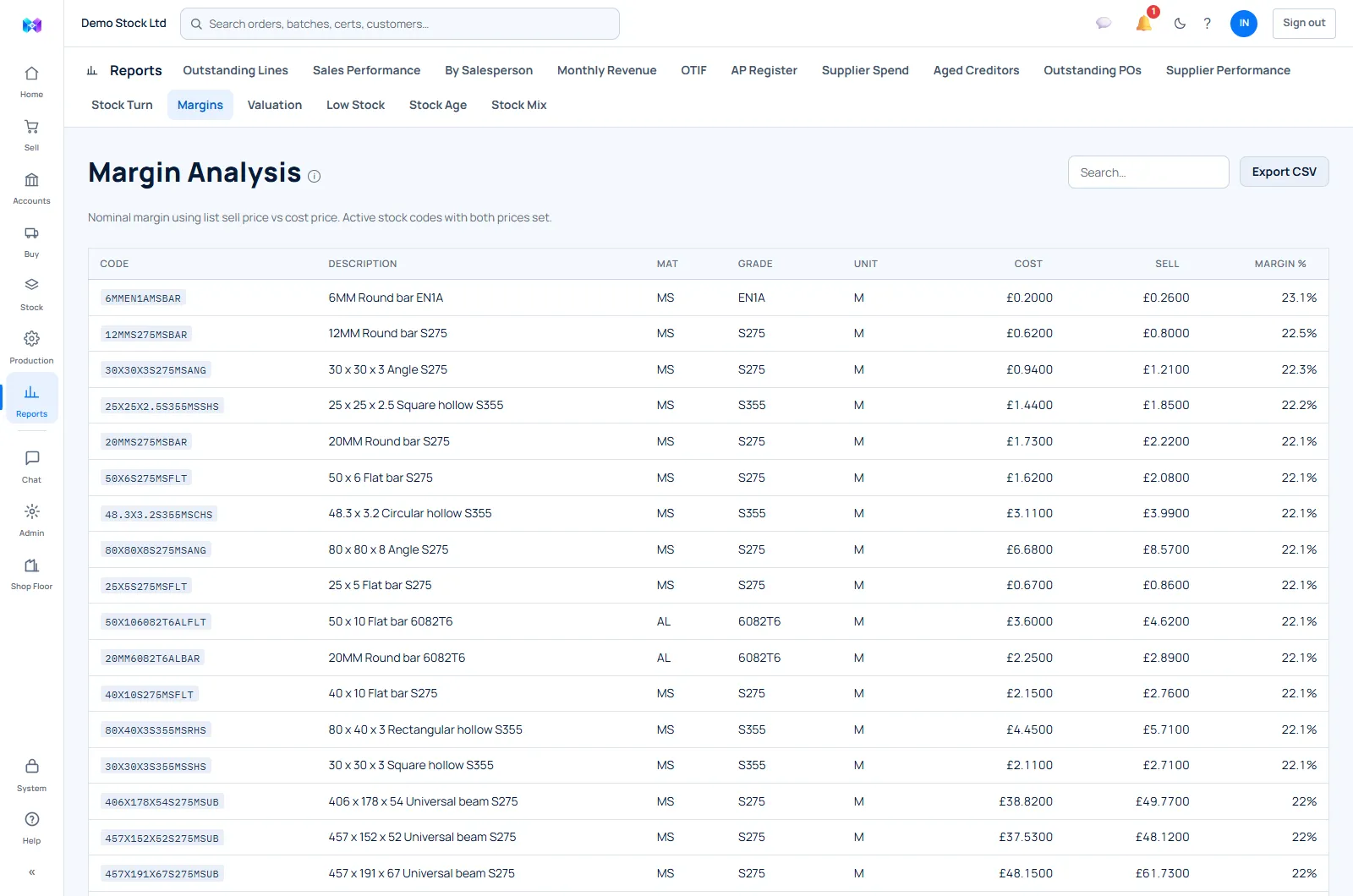
Fixed report screens cover sales performance, OTIF, margins, stock valuation, stock age and turn, supplier spend and performance, AP register and aged debt.
Demand forecasting reads despatch history to flag shortages and suggest reorders. KPI alerts fire when on-time delivery, aged debt or works-order lateness moves outside its normal band.
What this saves you
The Monday-morning hour of pasting numbers into a spreadsheet nobody quite trusts.
Paperwork in, answers out.
AI capture reads mill certs, delivery notes, customer POs, supplier confirmations and subcontract paperwork into reviewable drafts.
The assistant answers operational questions from your live data and builds tables and charts on demand. Read-only by design.
Writes only happen through explicit confirmation. The AI proposes; your team decides.
What this saves you
Typing, mostly. And the reports that used to need someone technical.
And everything the modules hang off.
The nine above are the spine. This is the finance, integration and platform layer that ships alongside them. All live, none of it a roadmap. Which tier switches on what is on the pricing page.
Production & the shop floor
Works orders turn bar and plate into cut product, saleable remnants and scrap. You see the theoretical yield, kerf and end-trim allowed for, before anyone touches a saw. Schedule jobs against machine capacity, and run the floor from a tablet that keeps working when the wifi drops. Every start, pause and downtime reason is logged against the heat number.
Quotes that close themselves
Priced quotations with the theoretical weight worked out from the section. Email one and the customer accepts or rejects online without logging in; a won quote converts to an order in a single atomic step, and a dead one auto-expires so it stops holding stock.
Credit control & statutory interest
A live credit gate, separate from stock. It totals exposure across open invoices and undespatched orders against the limit, and scores the account 0 to 100 for risk. An account stop blocks orders and despatch, and nightly rules can trigger it for you. It also charges statutory late-payment interest under the 1998 Act: base rate plus 8%, the fixed compensation bands, VAT-exempt. Overrides need a reason, and the reason is the trail.
Online payments
Pay-now links on invoices, reminders and the portal, settling into your own Stripe account. You are the merchant of record, and we never hold your money. Card on smaller invoices, Bacs Direct Debit on larger ones, and refunds that start from a credit note and can't be paid twice.
Multi-currency
Spot rates and forward contracts to hedge foreign customers and suppliers, with a live mark-to-market against the latest rate and a settle-at-actual that records the realised gain or loss.
Fleet & transport
Vehicles and drivers with their MOT, insurance, licence and CPC dates watched for you. Group delivery notes onto a load, sequence the drops and confirm. An expired document blocks departure at the desk, instead of being discovered at the gate.
EDI
EDIFACT and X12 trading partners: inbound purchase orders land as draft sales orders, order responses, despatch advices and invoices go back out, and every message is logged with a retry when something bounces.
Certificate analysis & spec checks
A dedicated analysis desk. Drop in a mill cert and it's read and checked against the whole specification library at once (every standard the material passes, dual-certification candidates flagged), plus a three-document contract review that cross-checks the customer PO, the certificate and the mill confirmation.
Chat, notifications & support
Messaging between your own people with presence and file share, a notification bell for the things actually addressed to you, and support tickets triaged instantly by AI but always seen by a human.
Admin, security & GDPR
Roles that hide whole areas from people who don't need them, an immutable audit log of who changed what and when, two-factor sign-in, and GDPR erasure that scrubs the person while keeping the financial trail intact. Your data lives in London.
Everything, one line each.
The complete feature list, synced straight from the product. A feature cannot ship without a row appearing here: the product's own build enforces it.
Home & personal productivity
- Role dashboards. four fixed views (Sales, Accounts, Operations, Management), each built around the queues that role needs, with a switch offering only the views yours can open.
- One-click queues. company-wide worklists (your own rows marked first) that link straight to the quote, order, invoice or purchase order behind them.
- Trend charts with ranges. headline revenue/orders/despatch sparklines over 30d/60d/90d/12m.
- Team on duty. live online/away presence for your team with what each person is carrying.
- Notifications & KPI alerts. a bell for your events (one on/off switch per notification type, default on, governing bell and email; emails deep-link to the exact record), plus statistical alerts when a KPI moves outside normal.
- Team chat. intra-company messaging with presence, backed by your own database.
- Global search. one box across customers, orders, invoices, stock and more.
- AI assistant. ask questions, generate any report or chart on demand, and propose actions ("raise the PO") in plain English; every action shows a confirmation card of exactly what will be written and only runs once you confirm.
- Guided onboarding. a getting-started path from first login to first invoice.
Sales: quote to despatch
- Quotes. enquiry to quote to order in one flow, with public quote links customers can open without a login.
- Quotes list. open quotes sorted by valid-until date, cards that count and filter what needs sending, is awaiting a reply, expires within a week or is won and waiting to convert, Open / Drafts / Closed / All tabs, a next-step link on every open quote and two short queues of what to chase first.
- Pricing. sales price rules and a per-stock-code price book on their own Sell screen; rules resolve each customer's net price, the book holds list, minimum and maximum prices.
- Customer PO import. drop in the customer's purchase order, scan or photo, and MetlSys reads the prices, grades, specifications and delivery requirements, matches the customer and your stock codes, spots a PO you have already had, and attaches the original to the order.
- One order screen. customer, stock code, batch, quantity, for the whole life of the order: pick the actual material off the shelf with its free stock in view, the stock code dropdown shows Total, Allocated and Free per code, then cut-piece pricing, processing steps, live margin badge and credit checks as you type.
- Sales orders list. open orders sorted by delivery date, cards that count and filter what needs allocating, despatching or is due within a week, Open / Drafts / Complete / All tabs, a next-step link on every order and two short queues of what to do first.
- Order detail: line rail and line editor. the order's lines as a row of cards with the selected line in a focus box below; on a draft, add, edit and remove lines in the line editor; on a confirmed order, read the line's quantity, price, margin, batch and next step and use **Edit line** to change quantity (which re-prices the line), price basis, product form, dimensions and notes, locked to notes only once any of the line has been despatched.
- Margin floors. price-floor rules by customer, band, stock code or grade (absolute £/kg, margin % or £/tonne contribution) with warn / block / approve enforcement, and an approval queue for overrides so unprofitable orders never slip through.
- Back-to-back trading. ringfenced stock for B2B deals, direct-ship from supplier to customer, merchanting margin tracking.
- Despatch & load planning. delivery notes, per-drop load boards, collections and haulier recharges.
- Delivery notes list. open notes oldest first, cards that count and filter what is waiting to be invoiced, waiting for proof of delivery, has a delivery exception or went out in the last 7 days, Open / Complete / All / Voided tabs, a next-step link on every note and two short queues of what to chase first.
- Cert packs & ePOD. certificate bundles emailed at despatch; drivers capture signatures on a phone via a token link, and the signature is **printed on the delivery note itself**, so the copy you file, email or share is the proof of delivery.
- Billable carriage. a delivery charge that rides the order through to the invoice, with the VAT treatment you choose.
- Delivery exceptions. shortages and damage recorded at the door, and countable from the delivery-note list.
- Alloy surcharge billing. choose per line whether the surcharge is included in the price or itemised on top; confirming freezes the rate and it carries through despatch to the invoice, broken out on the same line like VAT.
Finance & credit
- Invoicing. invoice straight from despatch with the full allocation chain intact; credit notes for partials, returns and refunds.
- Invoices list. open invoices sorted by due date, cards that count what is unpaid, part paid, overdue or due within a week (the overdue figure matches the dashboard), Open / Complete / All tabs, a chase or record-payment link on every open invoice and two short queues: longest overdue and delivered-but-not-invoiced.
- Credit notes list. credit notes still needing action, oldest first, cards that count and filter what is a draft, issued but not yet applied, or unapplied for over 30 days, Open / Complete / All tabs, an issue or apply link on every open credit note and two short queues: longest waiting to be applied and drafts waiting to be issued.
- Credit control. live exposure, credit limits, credit stop and auto-stop rules, aged debtors (money paid but not yet allocated counts as credit and shows as its own line), with a single **on/off switch** for firms that don't run credit control at all.
- Dunning & statements. a configurable reminder ladder with email templates and scheduled statements; a send that fails is retried on the next run and flagged to you after three failures.
- Late-payment interest. statutory interest, base-rate tracking and compensation documents, per tenant.
- Online payments. Stripe pay-now links and refunds; money lands with the invoice reconciled.
- Accounting export & FX. ledger-ready exports, multi-currency rates, per-customer VAT codes.
Purchasing & planning
- Purchase orders. supplier management with performance and spend reporting, overdue-PO tracking; cancel an order with nothing received, email it to the supplier, amend it before anything is received, and close or reopen one with On Order kept in step.
- Purchase orders list. open orders sorted by due date, cards that count and filter what is still to receive, part received, overdue or due within a week, Open / Complete / All tabs, a next-step link (receive, receive balance or chase) on every open order and two short queues of what to chase first.
- Suppliers list. active suppliers by name, cards that count and filter overdue payables, late deliveries, QA approvals needing review and suppliers gone quiet for 90 days, Active / On hold / All tabs, sorts by oldest overdue payable or oldest late delivery, a next-step link (review hold, pay, chase delivery, review QA or follow up) on every supplier that needs one and two short queues of who to pay and whose delivery is latest.
- Goods in. GRNs with weighbridge weights and AI-extracted mill certificates attached at the door.
- Goods-in list. receipts that still need something done, oldest first, cards that count and filter what is awaiting weight, awaiting a certificate, waiting for a supplier invoice or in discrepancy (a failed spec check or a held invoice variance), Open / Complete / All tabs, a next-step link on every open receipt and two short queues of what has waited longest.
- AP register. three-way matching and an awaiting-payment queue.
- Subcontracting. send stock out for external processing and track it home again.
- Subcontracts list. orders still to do sorted by expected return date, cards that count and filter what is still to send, out at a subcontractor, overdue or waiting for the subcontractor's invoice, Open / Complete / Cancelled / All tabs, a next-step link (send, receive, chase or invoice) on every open order and two short queues of what is out longest and what is waiting to be invoiced.
- Purchase planning. reorder engine, demand forecasting, supplier-slippage RAG and stock projection, refreshed nightly.
Stock & traceability
- Batch-level traceability. every kilo tied to its batch, cert and location, from GRN to invoice.
- Batches list. batches in stock oldest first, cards that count and filter what is awaiting weight, has no certificate, is on hold or is fully allocated, In stock / Allocated / Exhausted / All tabs, a next-step link (confirm weight, review or add certificate) on every batch that needs one and two short queues of what to deal with first.
- Stock items list. product codes in stock, out of stock or inactive, cards that count and filter what is below its reorder point, short for open orders, on order or slow moving, a next-step link (reorder, receive or review) on every code that needs one, a most-short-first sort and two short queues of what to reorder first.
- MTC register. EN 10204 certificate types, grade reference data and an unbroken direct-ship cert chain.
- Certificates list. certificates that still need something done, oldest first, cards that count and filter what is not linked to a batch, missing analysis or type, held in quarantine or unverified for 30+ days, Open / Complete / All tabs, a next-step link (link a batch, complete the data, review the spec check or verify) on every open certificate and two short queues of what has waited longest.
- Remnant management. remnant register with valuation policy and cost inheritance on cut children; remnant-first allocation.
- Warehouse locations. put-away and location tracking.
- Quality workflows. stock adjustments, scrap dashboard, NCR / RMA with assignment and ageing.
- Stock adjustments list. Active / Reversed / All tabs newest first, cards that count and filter write-offs, quarantine holds and high-value moves (£500+), a Reverse next-step link on every reversible adjustment and two short queues of the latest write-offs and active quarantine holds.
- Scrap disposals list. All / Recent (30 days) tabs newest first, a card that counts and filters high-value disposals (£500+ credit), current holdings on hand and a queue of the heaviest scrap types still awaiting disposal.
- NCR / RMA list. open NCRs oldest first, cards that count and filter what needs a decision, has been open over 30 days, is supplier-caused or is holding stock in quarantine, Open / Closed / All tabs, a next-step link (investigate, disposition or close) on every open NCR and two short queues of what has waited longest.
- Stock reporting. valuation, stock turn, age bands, mix and low-stock alerts.
Production
- Works orders. queue to in-progress to complete, with yield, remnant and scrap captured per job; a completion that stopped part-way can be reopened; every works order is raised from a sales order line, so each job traces to the customer order it serves and none can be started from nothing.
- Works orders list. open jobs sortable by delivery date, cards that count and filter what is queued, not yet booked on the schedule, in progress or due within a week, Open / Complete / Cancelled / All tabs, a next-step link (schedule, start or complete) on every open job and two short queues of what to run next.
- Production schedule. cutting and processing planned against saw and machine capacity; the Unscheduled queue carries Overdue / Due within 7 days focus cards, a due-date sort, real paging and a summary endpoint, alongside the drag-and-drop Gantt board (kept as-is).
- Machine & shift setup. define work centres, per-machine efficiency and weekly shift patterns that drive schedule-board capacity.
- Shop-floor PWA. an offline-capable operator app with PIN login; events queue and sync when the network returns.
Certificate analysis (Analyse)
- Certificate analysis. upload a mill cert, AI extracts the chemistry/mechanicals and checks conformance against the spec.
- Spec library. a maintained standards library, a separate copy per company, with admin tooling for your own specs.
- Contract review. PO vs mill confirmation vs certificate, cross-checked automatically.
- Contract review sign-off. on a draft sales order: sign off a matched review, sign off discrepancies with an override note, or record a manual review; Confirm stays blocked until signed off.
- Certificate history. every analysis searchable and re-downloadable.
- Contract review list. your own reviews with All / Pass / Fail tabs, Missing data and This week focus cards, a next-step link on every failed review, and real (offset) paging, with a Mine / Team scope toggle (Team is depot-wide, role-gated) and a Last-30-days focus fed by the analysis dashboard's Reviews (30d) tile. The analysis dashboard also lists alert tiles (failed reviews this week, reviews missing data, no certificate upload in 7 days).
Furnace data
- Furnace recorder files. the recorder pushes a daily `.DAD` file by FTP to the MetlSys receiver (Fly.io, IP-locked, upload-only); files are archived, decoded into readings and messages, listed with `.DAD`/CSV download and manual upload; connection screen sets the allowed IP and issues a one-time password.
- Furnace trend, cycles, deviations & maintenance health. auto-detected heat cycles with time at temperature, overshoot/load-lag/sensor-fault deviations and a weekly per-furnace maintenance-health light, computed from the recorder readings after every file arrives; per-furnace thresholds are admin-editable and recompute the whole history on save; a dashboard tile per furnace shows its current state at a glance, plus red/amber alert tiles for anything needing attention (stale recorder, failed files, poor sensor health, rising deviations, an unusually long open cycle).
Customers & portal
- Customer directory. accounts, contacts, per-contact salesperson, statements and credit terms in one place.
- Customers list. active customers by account code, cards that count and filter what is overdue, over its credit limit, on a credit stop or has not ordered in 90 days, Active / On hold / All tabs, a next-step link (review hold, review credit, chase or follow up) on every account that needs one and two short queues of who to chase and whose credit to review.
- Customer portal. customers self-serve orders, certs and documents under their own login; staff manage every portal user from one directory, invite included.
- Public token pages. pay-now and quote pages that need no account at all.
Platform & administration
- Users & roles. role-scoped navigation, invites, a main role plus optional extra roles per member, MFA, terms-of-service clickwrap.
- Modules. admins switch screens on or off company-wide; server-enforced, never grants above your subscription tier.
- Light and dark. a theme that follows your system or your choice, on every screen.
- Company settings. branding, document terms, analysis codes, EDI, data import.
- AI-assisted migration. upload your old system's spreadsheet export and MetlSys works out which column is which field, shows you its confidence, and only writes what you approve.
- Fleet & transport. vehicles, drivers, loads and compliance dates; expired/expiring flags use a 60-day window.
- Expiry reminders. daily bell/email reminders to admins and managers at 60 days, 30 days, on expiry and monthly after, for vehicle MOT/insurance/tax, driver licence/CPC and supplier QA approval.
- Audit trail. every change logged with who/when, browsable in-app.
- Multi-company. schema-per-tenant isolation with a one-click company switcher; UK-resident data.
- Plans & billing. Lite / Professional / Corporate tiers with seat management.
- AI usage credit. a monthly £ allowance per plan plus prepaid top-up packs meters every AI feature, so a company always knows its AI spend before it runs out.
- Support with AI triage. in-app tickets, first-line answers grounded in the product's own help corpus.
- In-app help. a per-module help drawer; the same corpus powers the AI assistant's answers.
The whole operation. One batch record.
See it joined up on your own workflow. Goods-in to invoice in one demo.