Material traceability software for fabricators and engineering firms.
MetlSys is material traceability for the buying side: the engineering businesses and fabricators that hold certified material, subcontract operations out and back, and have to answer for both when an audit arrives.
It is the same discipline a stockholder runs, pointed the other way. You are not selling the steel, you are consuming it, but the questions are identical: which heat was that, where is its certificate, what did the finished job actually cost.
Traceability starts at the purchase order, not at the audit.
The certificate requirement, the heat number and the cost all attach to the material on the way in, which is the only point at which attaching them is cheap.
Buy it with the requirement stated
Purchase orders for bar, plate or tube carry the certificate requirement up front, rather than it being remembered at goods-in. A grade can also carry a default minimum certificate type, so the requirement follows the material instead of the person who raised the order.
Receive it against the certificate
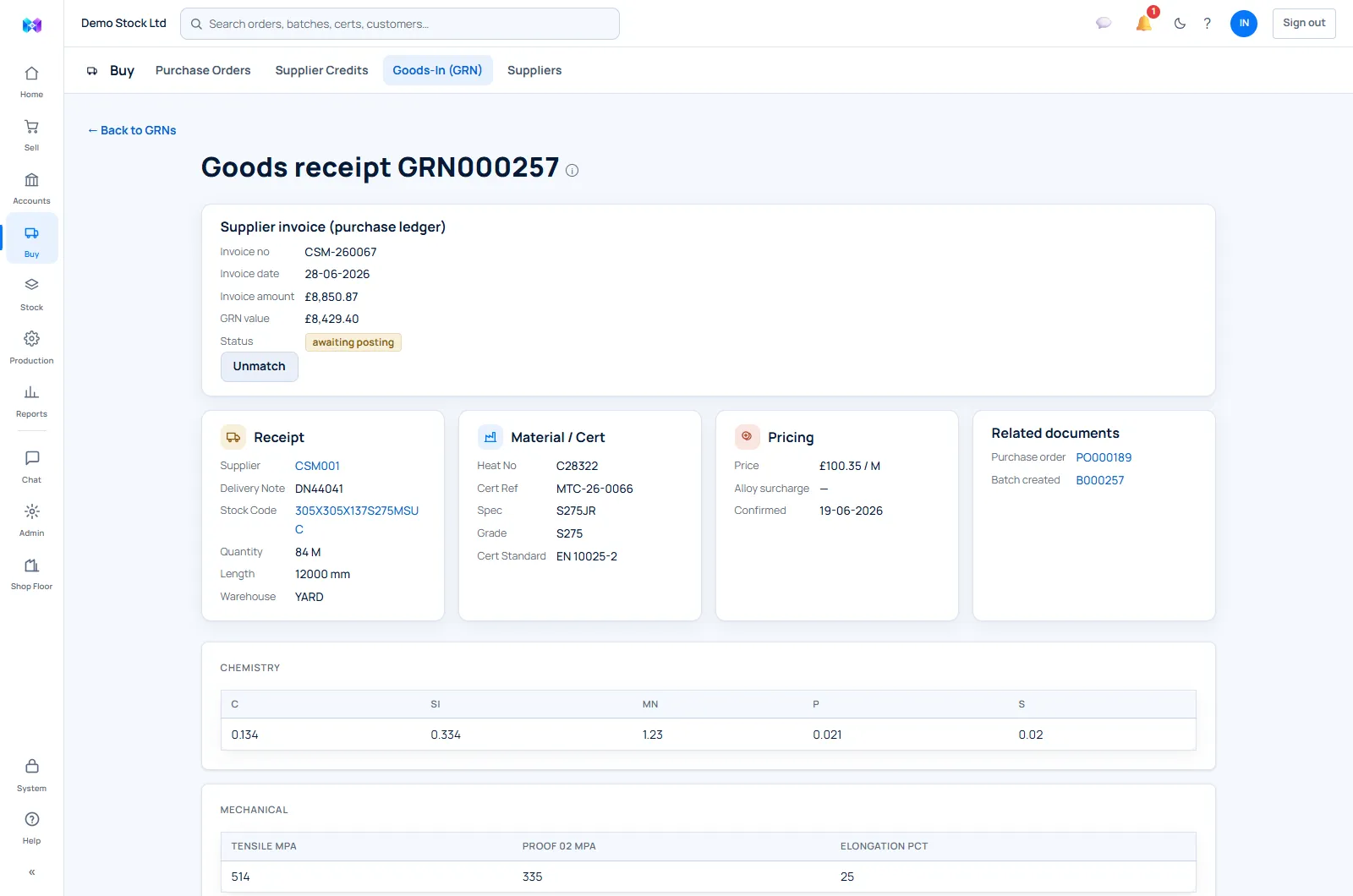
Drop the delivery note and the mill test certificate on the goods receipt. The extraction reads supplier, heat, grade, certificate type, chemistry and mechanicals into a draft you confirm, and the certificate links to the batch by heat number. Chemistry and mechanicals are on record from the day it arrives.
Hold stock you can actually answer for
Every length in the racks knows its heat, certificate, cost and location, down to warehouse, section and bin. A batch states what was received, what is free to allocate and what is committed, order by order, so a stocktake stops being archaeology.
The evidence is already assembled.
Every change is logged with who made it and when, browsable in the app. Corrections to a batch, whether quantity, weight, location, grade, quarantine or write-off, go through one adjustments screen with a mandatory reason code, so the trail explains itself rather than needing someone to remember.
Material that fails a check is quarantined through a non-conformance record instead of being quietly set aside, and a non-conformance raised from a failed subcontract return carries the subcontract reference, so the trail leads back to the operation that caused it.
Certificate analysis is searchable and re-downloadable after the fact, and contract review runs a three document inspection: the purchase order, the mill test certificate and, where you have one, the mill confirmation, cross-checked against each other and the specification library. The purchase order governs, so everything is checked back to what was actually ordered: the specification and its limits, the certificate type, testing requirements, delivery condition, and whether grade and dimensions agree across all three documents.
Send parts out without losing the trail.
Machining, heat treatment, grinding, plating or testing at an outside supplier, tracked as material that is off your floor but still on your books.
Off site means off the available figure
A batch at a subcontractor cannot be sold, allocated or cut, and it drops out of available stock. It still appears in what you physically hold, so the two figures never quietly disagree.
Paperwork travels with the metal
A subcontract despatch note lists the batches, the heat and cast numbers, the operation and the expected return date, with space for the subcontractor to sign on receipt.
It comes back certified
A passed return consumes the original batch and books a child that carries the heat number and the certificate through, with the certificate re-linked rather than referenced, so it is ready to use immediately.
And it comes back costed
The child’s unit cost is increased by the agreed charge, spread across the quantity returned. Sending raises a purchase order to the subcontractor, and their invoice is mirrored onto it, so the spend runs through invoice matching like any other.
What the job cost, rather than what you hoped it cost.
Material, processing and subcontract costs all land on the batch, so the margin on a job is a figure you can read rather than one you reconstruct.
Cost survives the cut
Every child batch inherits the parent’s purchase cost, and cut product pieces carry the parent’s full unit cost, so batch level margins are still there after the material has been through the saw.
Offcuts are stock, not waste
Remnants at or above your minimum length go back into stock as batches in their own right, priced by a valuation policy you set, so what is left on the rack is worth a known amount rather than nothing.
Yield is measured, not assumed
A works order records the actual yield percentage with the input, product, remnant and scrap weights, so material conservation on a job can be audited rather than argued about.
Supplier spend in one place
Purchase orders, an awaiting payment queue, three way matching and supplier spend and performance reporting sit alongside the material, not in a separate system that has to be reconciled to it.
Bring a job and an auditor's question.
Buy it, receive it against its certificate, send an operation out, bring it back and read the landed cost. Thirty minutes, your material.