Metal service centre software that follows the metal through every operation.
MetlSys is an ERP for UK metal service centres: the sites where a bar is cut, processed, sent out for treatment and brought back before it ever reaches a customer. One batch record carries the heat number, the certificate and the cost through every one of those steps.
Most stock systems record a receipt and a sale, and treat everything in between as a note in a comments box. A multi-process site needs the middle to be the system. That is what this page is about: what happens to a batch between the rack and the wagon, and where the cost of each operation ends up.
A single stock line cannot describe a bar that is halfway through four operations.
Stock in MetlSys is batch-tracked. Every physical lot keeps its own quantity, weight, location, heat number and certificate, and every operation on it leaves a record.
One code, several states at once
In stock counts everything physically present across a code's batches, including the material that is not sellable yet: awaiting weight, in quarantine, on hold, or away at a subcontractor. Free stock counts only the sellable part. Both are counted from the batches every time you look, so a surprising figure is a batch status, not a total that drifted.
Every cut is a record, not a note
A works order consumes the parent bars and creates the output batches in one step: one batch per cut length, remnant batches at or above your minimum length, and scrap below it. The works order records the actual yield percentage along with the input, product, remnant and scrap weights, so material conservation can be audited.
Genealogy survives the saw
Every output inherits the parent's heat number, certificate, grade, spec and finish, and stays linked back to the parent batch and the works order. A completed works order is locked and cannot be re-cut.
Plan the floor, do not just write down what it did.
Cutting and processing are scheduled against real capacity, and the shop floor reports back into the same record the office is looking at.
Capacity, not a wish list
The production schedule plans cutting and processing against saw and machine capacity. You define the work centres, the efficiency of each machine and the weekly shift patterns, and those figures are what the schedule board plans with.
The works order list is the work queue
Works orders linked to a sales order show that order number, the customer and the delivery date, and the list sorts by delivery date, soonest first, instead of by whatever was raised last.
A shop floor app that survives the wifi
Operators work on a tablet with a PIN login. Events queue locally and sync when the network comes back, so a dead spot in the middle of the building does not stop the job being recorded.
Completing a cut updates the order
On a works order linked to a sales order, completing the cut re-points that line’s allocation at the cut pieces and marks it picked. Despatch then sends the products the warehouse actually made, with no manual re-allocation, and the remnants go back to free stock.
The subcontract loop, with the money attached.
Send a batch out for heat treatment, machining, grinding, plating, testing or cutting and it moves to at-subcontractor. While it is in that state it cannot be sold, allocated to a sales order or cut on a works order, and it drops out of your available stock. You cannot promise material that is sitting at a third party.
Sending also raises a purchase order to the subcontractor for the agreed cost. When you record their invoice it is mirrored onto that purchase order and a service receipt is booked against it, so the spend runs through invoice matching and the purchase ledger posting run like any other supplier invoice.
A passed return consumes the original batch and books a child batch that carries the heat number and the certificate through. The certificate is re-linked to the child rather than just its reference, so the returned material clears the despatch certificate check straight away. A failed return goes to quarantine with a non-conformance record that carries the subcontract reference.
Where the cost lands
The child batch’s unit cost is increased by the agreed subcontract charge, spread across the quantity that came back. The operation is on the metal, not in a separate spreadsheet.
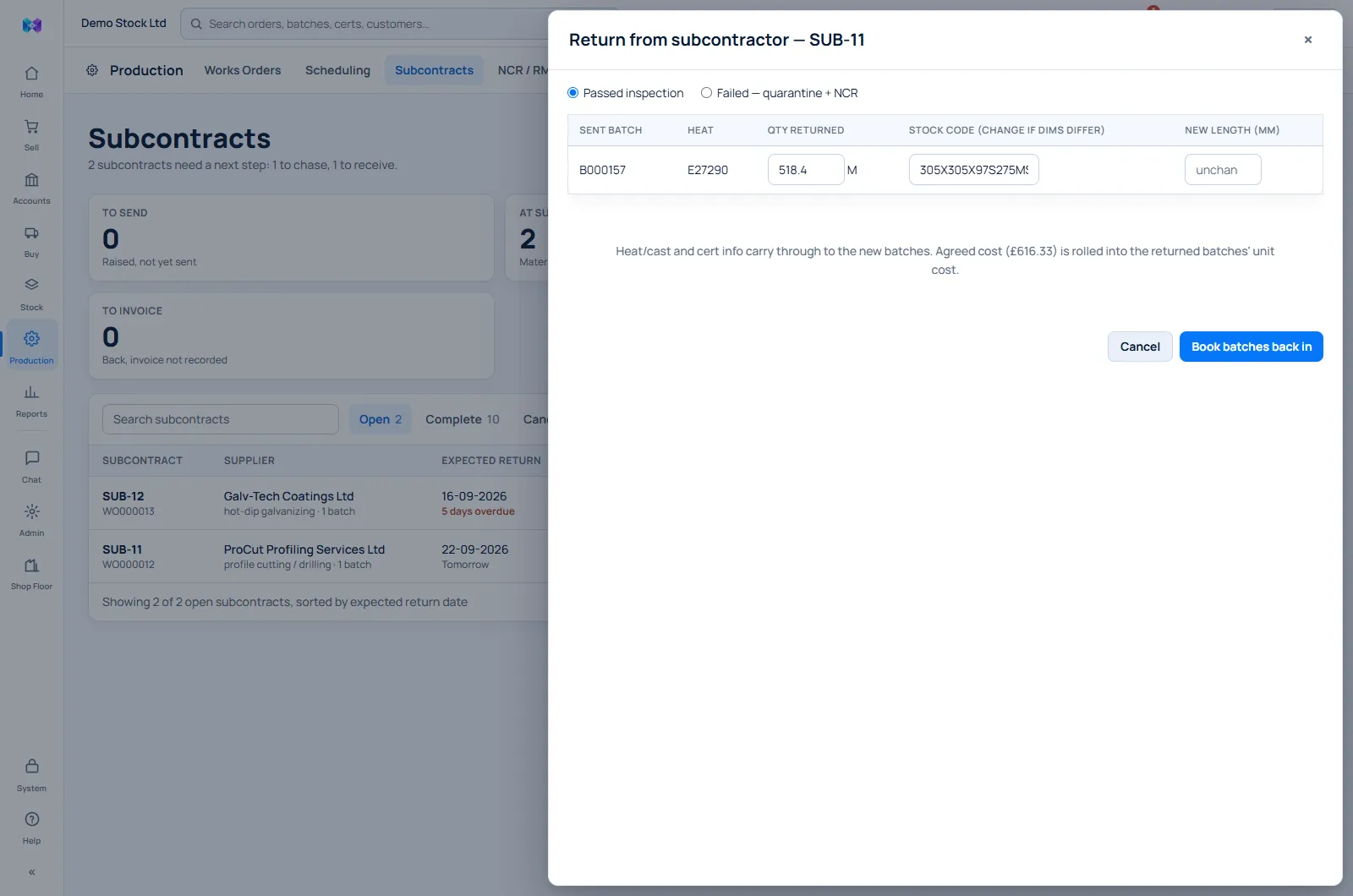
Cost that lands on the batch, so you can price from it.
A service centre sells the operation as much as the metal. If the operation's cost never reaches the material, the margin on the job is a guess.
Cutting does not lose the cost
Cut product pieces carry the parent’s full unit cost, and every child batch inherits the parent’s purchase cost, so batch level margins survive being cut.
Remnants priced by policy, not by mood
A remnant returned to stock is priced by your remnant valuation policy: the parent’s cost per kg less a percentage (20% unless you change it), full cost unchanged, or capped at a net realisable value you set.
Cut piece pricing that matches the saw
Chargeable length is the cut length plus kerf plus a facing allowance at each end, with kerf set per saw type and minimum usable length flags so nobody promises an offcut that cannot exist.
Remnants get used before prime
When stock is allocated automatically, flagged remnants outrank prime full lengths of the same code. On a cut line, remnant recommendations score the candidates by least waste and oldest first, with a bonus for the same heat.
Bring your most awkward job to the demo.
A bar, three operations, one of them at a subcontractor. We will run it end to end and show you where the cost landed.