Stainless steel stockholder software, built around the heat number.
MetlSys is stock control and ERP for stainless steel stockholders: every physical lot is a batch, and every batch carries its grade, its finish, its heat number and its mill test certificate from goods-in to the customer’s certificate pack.
Stainless punishes a system that treats material as a quantity against a part number. The grade has to be exact, the finish has to survive being cut, and the paperwork has to be right before the wagon leaves, not found afterwards.
316 bright and 316 black are not the same stock line.
MetlSys separates what a product is from what a particular lot of it is, so grade and finish stay accurate through cutting, splitting and subcontract returns.
Four attributes make the code
A stock item is built from material, section, grade and finish, for example stainless, round bar, 316, bright. Codes follow a size, grade, material, section convention, so 20mm 316 stainless round bar reads as 20MM316SSR. Codes are unique per company, and legacy codes carried over from an old system keep working alongside the new ones.
Finish lives on the batch, not the code
Finish is deliberately not part of the stock code, because two lots of the same code can genuinely differ by it. It sits on the batch, defaults from the stock item at goods-in, and is inherited by every child batch from a split, a works order cut or a subcontract return. Bright and black stay distinguishable all the way to the delivery note.
A grade library the sales floor can use
Grade Reference searches by common code, werkstoff number, EN name, AISI or trade name, or UNS. It holds chemistry and mechanical limits, magnetic and hardenable properties and PRE, finds equivalents and substitutes that satisfy the same spec, prints a one page datasheet, and looks up surface finish codes from EN 10088-2 and EN 10088-3.
Certificates are records, checked against the grade.
A mill test certificate is a record in its own right, holding the certificate reference, heat number, certificate type, grade, standard, the chemical analysis, the mechanical results and the PDF. One certificate can cover several batches of the same heat.
Upload it on the goods receipt and the extraction reads the heat number, grade, certificate type, chemistry and mechanicals for you to confirm. Its values are then compared against the published specification limits for the grade, EN 10088 for stainless among them, and the certificate page shows each element with its value, the allowed range and a pass or fail. That check is advisory at goods-in: it flags the problem without blocking the receipt.
Loose certificates that turn up later can be matched to batches by heat number in one go, and anywhere MetlSys offers you a batch, one with no certificate linked to it is flagged on sight: on the batch picker, on the allocation picker, in the remnant register and in stock availability on a quote.
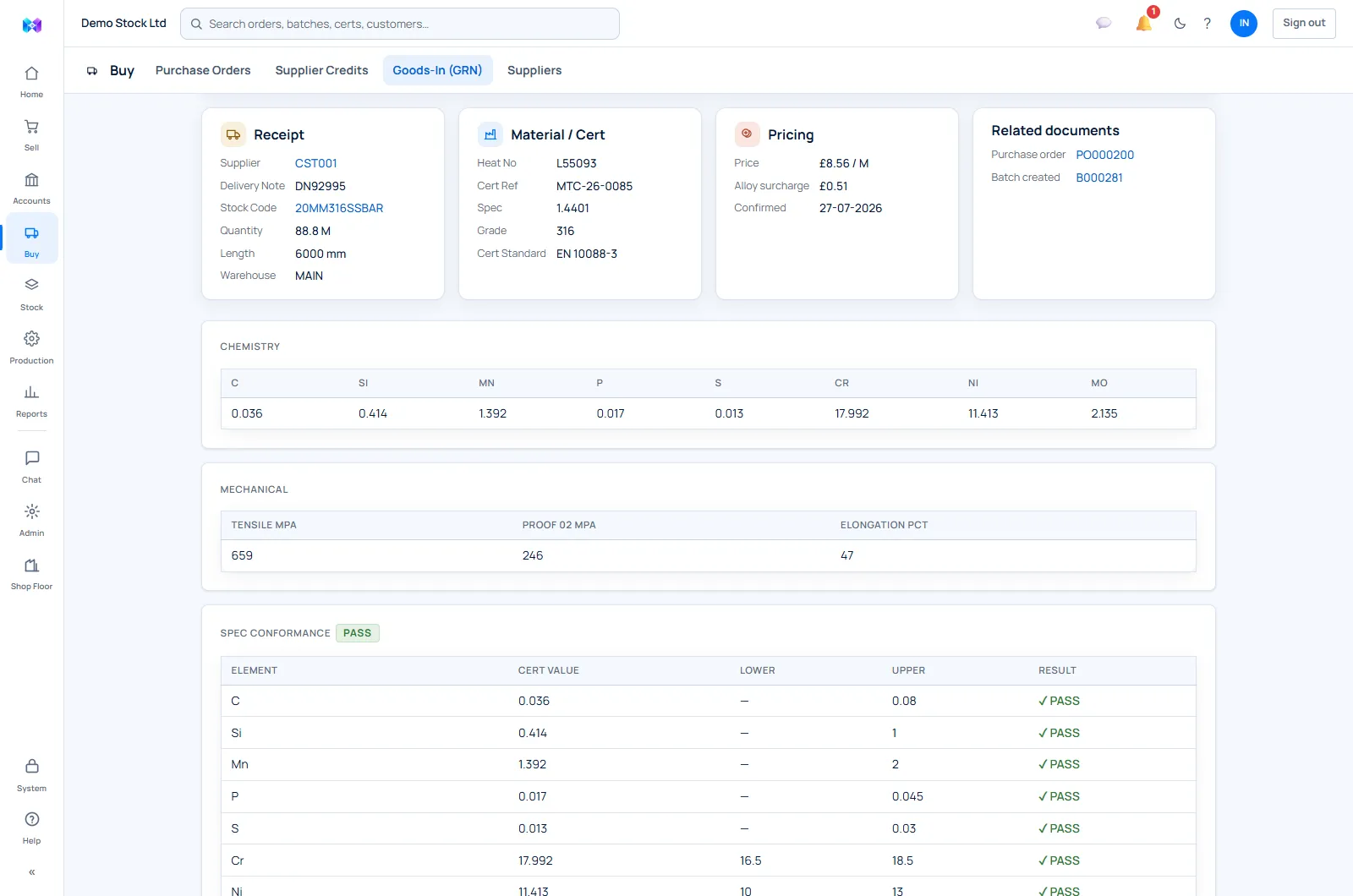
The paperwork is checked before the wagon moves.
A certificate requirement can sit on the customer, on the order line, or as a default on the grade. Despatch checks every delivery line against it.
Despatch blocks when
- ✕No certificate is linked to the batch, or the certificate PDF is missing.
- ✕The certificate type is below the type the customer or the order line requires.
- ✕The certificate's heat number or grade does not match the batch or the line.
- ✕A 3.1 or 3.2 certificate is missing its authoriser, or a 3.2 its inspector.
And what an override can and cannot do
Where the issue is a deficiency rather than a missing certificate, a manager can override it with a reason. Where the certificate is missing altogether, the override is refused: attach it to the batch instead.
If goods genuinely have to go before the paperwork arrives, an admin can force the despatch. That is recorded separately in the audit trail with the reason and which lines had no certificate, so it can be found and chased rather than forgotten.
Once the checks pass, MetlSys assembles a single certificate pack: a cover sheet listing every heat and certificate, then the copies, attached to the delivery note and to the customer’s portal bundle.
The heat number is the thread, and nothing on the floor cuts it.
Splitting a bar, cutting it on a works order or sending it out for polishing all produce child batches, and every one of them inherits the heat and the certificate.
Splits and cuts keep the genealogy
Splitting a batch creates a child remnant that inherits the heat and certificate, with weight apportioned and the genealogy recorded. A works order cut does the same for every product and remnant it produces, carrying the parent’s heat number, certificate, grade, spec and finish.
Subcontract returns ship straight away
Material back from polishing or testing books in as a child batch with the certificate re-linked to it, not just its reference copied across, so it clears the despatch certificate check without anyone re-matching paperwork first.
Alloy surcharges with an effective date
The grade master holds the standard, material type, density, default minimum certificate type and the current alloy surcharge. Surcharges are held with an effective date, so pricing picks up the rate that applied.
Every kilo tied to its batch
A batch holds quantity, weight (theoretical and actual), length, warehouse location and status, and states what is received, free to allocate and committed, order by order, so you can see who is holding stock before you take any.
Bring your worst mill certificate.
We will read it, file it by heat, check it against the grade spec and try to despatch a batch that should not pass. Watch it get stopped.